
St. Tammany City Directory Shelf
The St. Tammany Parish Library catalog is the main index to the local Polk shelf. Results have distinct subtitles for Covington, Covington/Mandeville, Slidell, parish-wide books, and a regional New Orleans Suburban volume. These are physical, library-use-only items unless a catalog record says otherwise. The listed years are surfaced holdings, not proof that every annual book was published or preserved.
| Collection | Years found | Where held | Access |
|---|---|---|---|
| Polk, Covington | 1979, 1982, 1985, 1987, 1989, 1991-1993 | Parish Library | Library use |
| Polk, Covington/Mandeville | 2000-2003 | Genealogy collection | Library use |
| Polk, Slidell | 1984, 1986-1994, 1996-2003 | Parish Library | Library use |
| Polk, Saint Tammany Parish | 2004-2021, with catalog gaps | Parish Library | Library use |
| New Orleans Suburban Polk | 1997 | Parish Library | Regional volume |
Record the subtitle, volume, call number, branch, and restriction. The common call-number pattern is Gen LA StT.122 Pol YYYY. A missing result can reflect a holdings gap, publication gap, or a book filed in local-history material. Ask staff before drawing a conclusion.
St. Tammany Directory Years by Place
Place matters most in the earlier runs. Covington books surface from 1979 through 1993, while the combined Covington/Mandeville subtitle appears from 2000 through 2003. Slidell has its own East Parish run from 1984 through 2003. A Slidell resident may be absent from a Covington volume without having left St. Tammany Parish.
The parish-wide subtitle begins in surfaced 2004 holdings and continues through 2021, with some years split into volumes. The catalog shows only volume 2 for 2018 and 2021. That does not prove volume 1 never existed. The 1997 regional book spans St. Tammany and nearby parishes, so confirm the community’s legal location.
Note: A directory subtitle defines the search area more reliably than the word “Polk” on its spine.
View the St. Tammany Catalog
The library’s catalog results show how titles, years, call numbers, and availability appear before a branch visit.
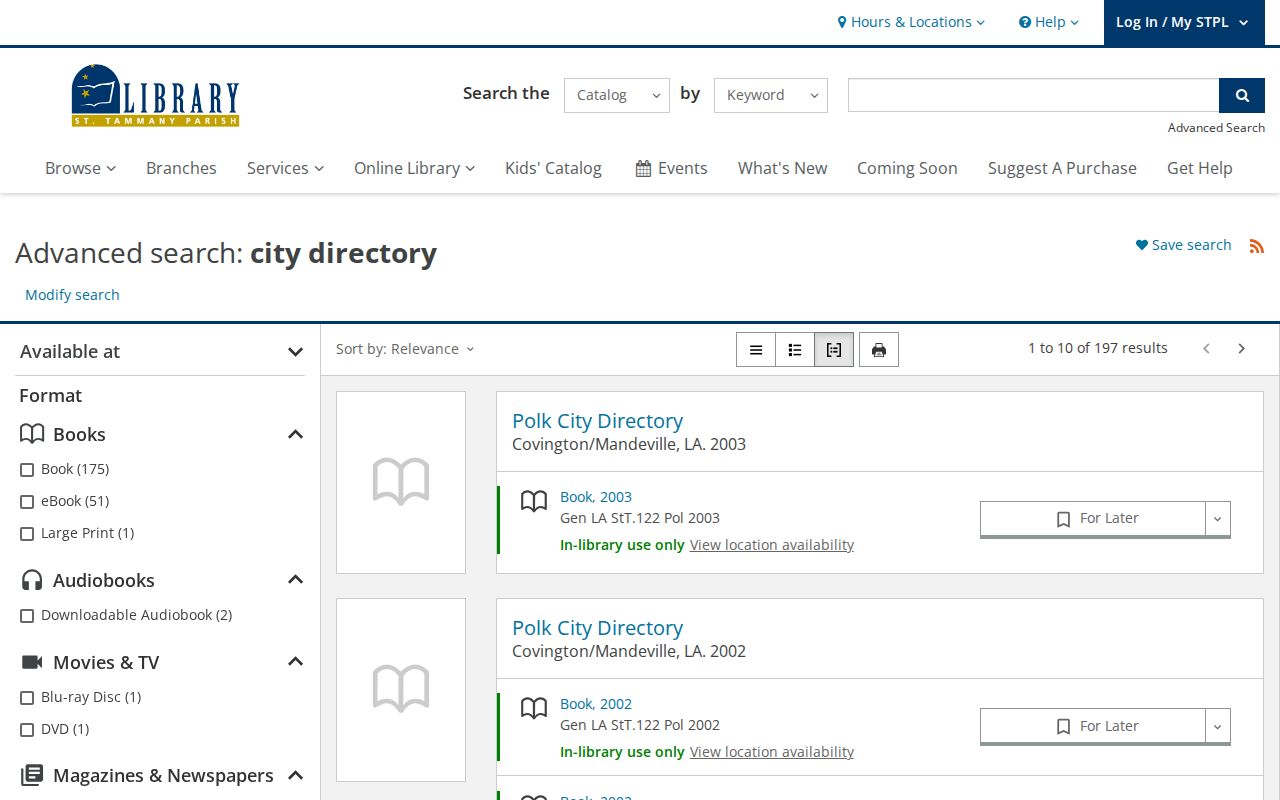
This is a catalog screen, not a scan of resident entries. Use its details to request the correct physical book and ask about uncataloged reverse sections.
Read St. Tammany City Directory Entries
A city directory entry is a publication-year snapshot. It may state a surname, initials, street address, occupation, employer, telephone number, or household marker. Conventions vary. Photograph the publisher’s key before interpreting a short form, and preserve spelling and street abbreviations as printed.
| Name | The listed person, sometimes reduced to initials. |
|---|---|
| Address | House number and street, perhaps with a unit or residence mark. |
| Work detail | An occupation or business that can separate same-name people. |
| Household mark | A publisher-specific clue about the listed householder. |
| Cross-reference | A pointer to another name, business, street, or section. |
The 2003 Covington/Mandeville catalog item identifies the book and call number but shows no entry image. Do not assume that a spouse mark or reverse section exists until the volume is checked.
- Criss-cross directory
- A section ordered by street or phone rather than surname.
- Householder index
- An address list keyed to the publisher’s household reference.
- Abbreviation key
- The volume’s guide to shortened words and symbols.
St. Tammany Genealogy Desk Access
Genealogy help at Covington is available at 985-893-6280, press 6, or genealogy-covington@stpl.us. General reference routes include Covington press 5, Mandeville at 985-626-4293 press 3, and Slidell at 985-646-6470 press 3. Ask which series contains a named place, address, and date.
The library lists Ancestry Library Edition at Covington and Slidell, plus HeritageQuest, MyHeritage, AmericanAncestors, NewsBank, Bayou State Periodical Index, and local-history tools under varying access rules. Record the database, publication, date, page, and terms used.
The library database directory identifies available tools.
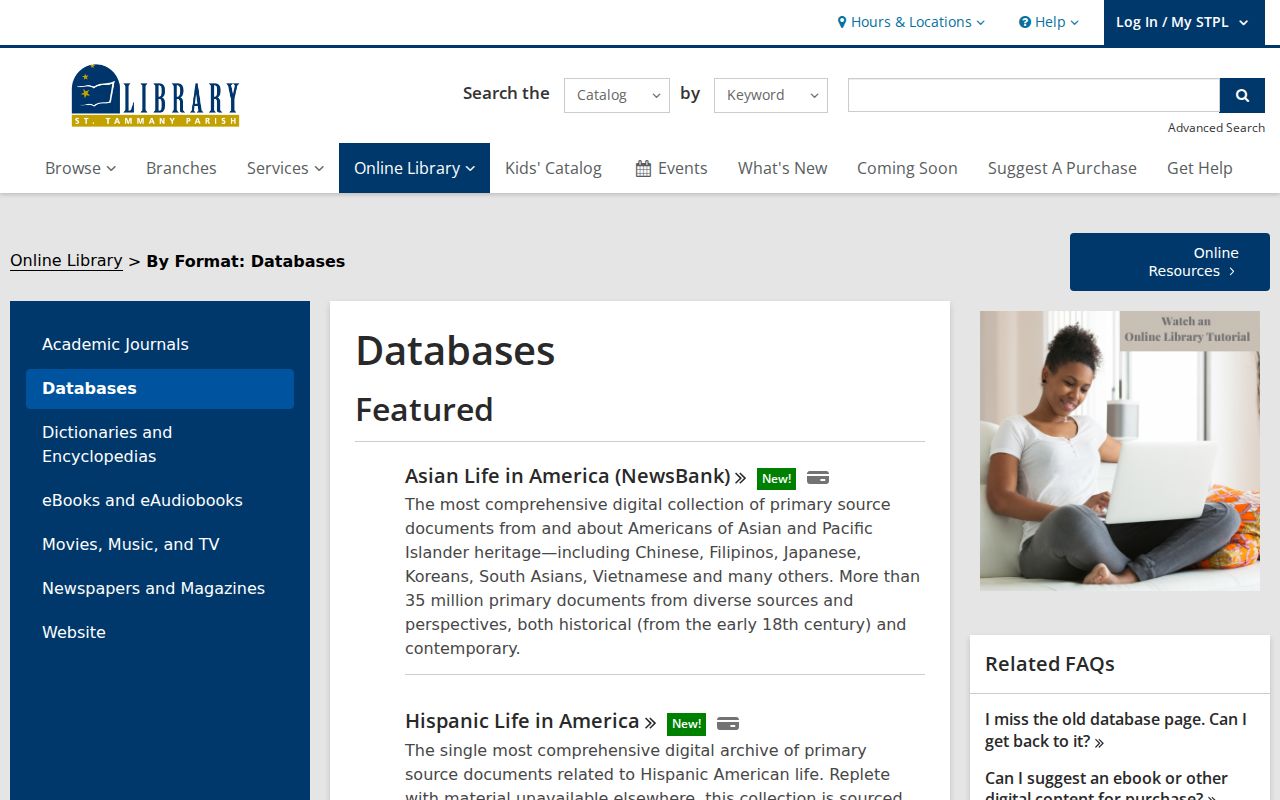
The list helps separate branch-only tools from home access. The source image citation remains more important than the search-result screen.
St. Tammany Reverse Directory Limits
Although Polk published cross-reference works, the inspected catalog did not confirm a complete local criss-cross run. Ask whether a specific book has a street-order section, whether telephone books fill the date, and whether local-history files hold an address index not shown online.
When no reverse section exists, start with a known surname. Once an address appears, compare nearby volumes. For modern records by address, use the St. Tammany Parish street directory process instead.
St. Tammany Directory Publishing Timeline
The catalog supports a useful timeline without implying a complete annual series.
| Year | Catalog milestone |
|---|---|
| 1979 | Earliest surfaced Covington Polk volume. |
| 1984 | Earliest surfaced separate Slidell volume. |
| 1997 | Regional suburban volume includes parish communities. |
| 2000 | Combined Covington/Mandeville subtitle appears. |
| 2004 | Parish-wide subtitle appears. |
| 2021 | Latest surfaced holding, cataloged as volume 2. |
Directory facts can lag the cover year because canvassing and printing take time. Record both the book year and the date of each confirming record.
St. Tammany Records Beyond Polk
Earlier residents require a wider archive search. The Louisiana State Archives catalog covers census indexes, church and family history, immigration records, and selected vital material. Its finding aid calls St. Tammany Clerk microfilm “Various Records,” P1998-060, so request roll details.
The catalog leads to a series description, not proof that a person appears. The research library is open weekdays from 8 a.m. to 4 p.m.; general Archives hours extend to 4:30 p.m.
LSU’s Henry L. Garland Collection has typewritten St. Tammany abstract-of-title volumes 10-17 and conveyance-index volumes 18-20, including one for 1875-1895. Clerk Archives adds Marks & Brands from 1813-1965 and justice-of-the-peace hearings by ward from 1810-1935. These are not city directories, but they can connect an early rural family to land and ward records.
St. Tammany Directory Cemetery Clues
The last directory appearance does not prove death or departure. The library’s obituary and cemetery guide points to printed sources, microfilm, obituary indexes, cemetery maps, and the Covington Cemetery No. 1 plot index. That route is valuable when a death record remains closed.
Compare relatives, burial place, and publication date with the directory address. A Clerk succession file may add heirs or property, but it answers a separate legal question.
Trace St. Tammany Households by Directory
A sound household trail preserves what each record proves. Several dated snapshots are stronger than one name match.
- Search by community, year, Polk, and city directory; copy the exact catalog data.
- Read the alphabetical entry and publisher key. Check a street section only if present.
- Transcribe initials, address, occupation, household mark, and year without modernizing them.
- Move through nearby volumes and pair census years with books on either side.
- Compare the address with deeds, historical voter images, obituaries, cemetery data, or assessor records.
- Verify that regional places belonged to St. Tammany Parish for the date.
FamilySearch’s Louisiana, Orleans and St. Tammany voter registration collection covers 1867-1949. It may show residence, occupation, nativity, age, and naturalization details. Account and image rights can limit access. Preserve the film citation, compare the residence, and record conflicts rather than hiding them.
St. Tammany Archive Cross-Checks
Printed city directories become more useful when their entries are tested against the parish’s older record systems. St. Tammany Parish Clerk Archives begins its local collection story in 1810, but each series has a different span. Conveyance and mortgage records track property interests. Successions can identify heirs and representatives. Marriage, naturalization, notary, tax, inquest, marks-and-brands, and ward justice-of-the-peace files can place a person in a legal or community setting that a Polk volume never records. Ask for the series matching the date and event instead of requesting a broad name search.
The vocabulary also changes. Early land indexes may identify a seller as the vendor and a buyer as the vendee. Court material may be arranged by plaintiff and defendant, while marriage records use groom and bride. A rural record may be organized by ward, book and page, suit number, or notary rather than a modern address. Preserve those labels. They are the keys needed to reproduce a search at the Clerk counter, Louisiana State Archives, or LSU.
Directory geography needs equal care. St. Tammany Parish was created in 1810 and later lost territory as Washington and Tangipahoa parishes took shape. A family may appear in another parish’s records after a boundary change even when the household did not move. A regional city directory can also include a community as part of a service area without proving the address lay within St. Tammany’s legal boundary. Pair the date with historical geography, then compare the printed place with the deed description.
A reproducible cross-check records the city directory title, year, volume, page, exact entry, call number, and branch. Beside it, note the archival series, date, name role, book and page or instrument number, and office consulted. When sources disagree, keep both readings. Publication lag, initials, spelling shifts, parish boundaries, and address changes are possible explanations, but none should be chosen without another record.